Slide Show: Cuban Political Cartoonist Alfredo Pong


Click images to enlarge. Copyright 2011 Alfredo Pong (all rights reserved)

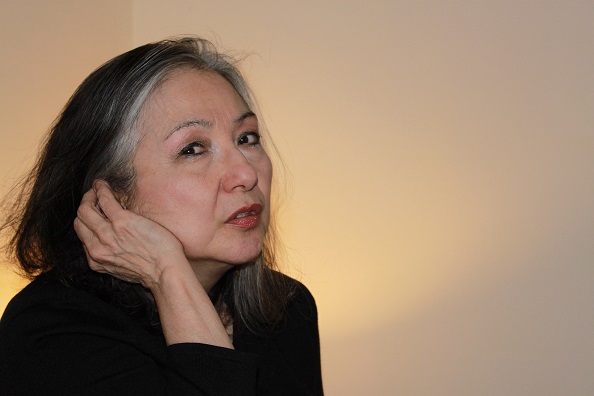
ALFREDO Pong

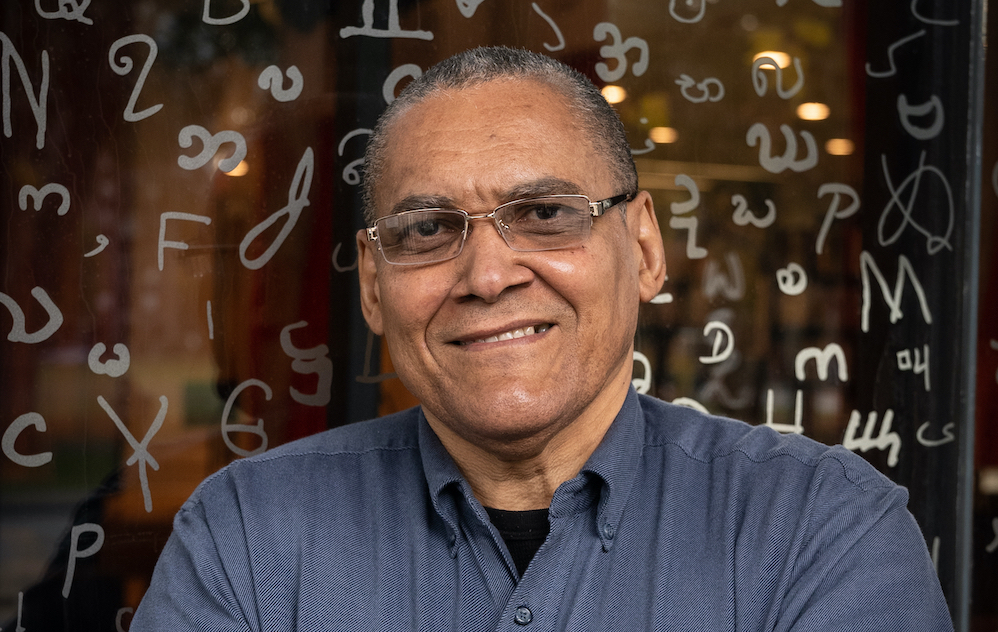
Political cartoonist Alfredo Pong

Alfredo Pong escaped Cuba for Vancouver, Canada in 1991, where he began to draw his first political cartoons.

By 1994 he had been hired by the newspaper El Nuevo Herald in Miami, where he continued cartooning for several years. Then in 1998 he connected with the online publication La Nueva Cuba.

These days his work is published on websites in the U.S., Brazil, Canada, Spain, Sweden, and Venezuela, and his personal blog can be accessed at cubahumor.com.

Reporters Without Borders has deemed Cuba “one of the world’s 10 most repressive countries, as regards online free expression.” Pong, who has admitted that he suffers an incurable case of “Castrophobia,” is among many exiled journalists who continue to fight for a free Cuba.

Read an interview with Alfredo Pong and other persecuted cartoonists in Sampsonia Way.

Slide Show: Burmese Political Cartoonist Aw Pi Kyeh


Click on images to enlarge. Copyright 2011 Aw Pi Kyeh (all rights reserved)

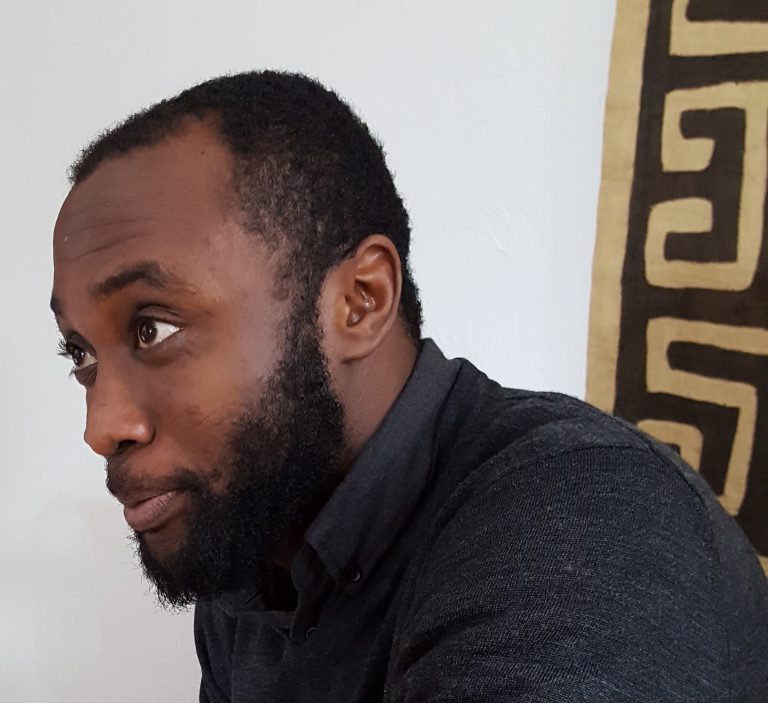
Aw Pi Kyeh (APK) chose this pen name because it means ‘loudspeaker’ in Burmese. His cartoons dare to shout out loud about the military junta that rules Burma.

Photo courtesy of Aw Pi Kyeh

In 2007 he was banned from publishing inside Burma after he supported monks in their peaceful protests during the Saffron Revolution. Following that, colleagues who even mentioned his name in an article were suppressed.
.
In June 2011, the Burmese site Mizzima.com, compiled the views of several well-known Burmese on the fighting between the national troops and the Kachin Independence Army, after both sides suffered heavy casualties. Aw Pi Kyeh commented, “The president said they would try to be a good government. What does good government mean? Is fighting good?”

After 30 years of cartooning, Aw Pi Kyeh says he will not quit. He continues to illustrate despite the ban on his work, and he has turned to new channels of distribution such as Facebook.

Read an interview with Aw Pi Kyeh and other persecuted cartoonists in Sampsonia Way.

Inside the Newsroom: Reporting Guatemala’s Drug Trafficking

Drug trafficking, and the violence it engenders, is Guatemala’s latest threat to freedom of speech. In her exclusive letter for Sampsonia Way, elPeriódico‘s Claudia Méndez Arriaza uses her inside-the-newsroom perspective to compare the risk of being a journalist today with the risks of reporting during Guatemala’s bloody civil war (1960-1996). She also discusses the necessary precautions for staying alive while reporting on drug-trafficking in one of the most violent cities in Latin America.

Confiscated drug money, Guatemala

The US State Department estimates that at least 75 percent of the drugs distributed in US territory are trafficked through Guatemala. The confiscation of drugs and money (as in the above photo) are events covered by the local media.

Long before I became a court reporter for elPeriódico de Guatemala, the career of many of my country’s journalists had been terminated. Some abandoned the newsrooms for less complicated jobs; others vanished from their desks and typewriters—only to show up in the morgues as further victims of political violence, or as one more desaparecido on the long list of casualties in Guatemala’s civil war.

Just type these five words into Google: “periodistas asesinados conflicto armado Guatemala” and the search engine will retrieve hundreds of thousands of pages. It is the same with any search, you might say. But there is a difference in this case: This is not just a search for the right restaurant or hotel; these are pages about reporters assassinated during the war; this is the history of journalism in my country.

And sometimes an internet search will show you what you don’t want to know. For example, in April 2000, a Spanish journalist was about to travel to Guatemala to work as a trainee for Prensa Libre, one of the country’s largest newspapers. When she tried to show her family the paper’s website, the computer screen showed the latest breaking news: A photographer had just been shot down while covering a violent demonstration. The journalist’s mother begged her not to travel to Guatemala, but she did, and that is how we, her Guatemalan peers, heard about that story. We could only laugh.

While doing my own Google searches about assassinated Guatemalan journalists, I found a website that compiles facts and figures I’d never seen all in one place. Reading this page, I learned that during the 36-year-long Guatemalan civil war 342 journalists were assassinated and 126 were illegally arrested or disappeared. That makes an average of at least one attack on the press per month, consistently, between the years of 1960 and 1996.

The statistics come from the Grupo de Apoyo Mutuo (GAM), a group of the victims’ relatives that emerged during the war. The website also says that there was no investigation into any of these deaths, nor has there ever been a trial for the case of a journalist who disappeared during that time.

Nonetheless, the same website explains that there is no longer a “política de estado,” or “state policy,” in Guatemala on violations of freedom of expression. Peace Accords were signed in 1996 at the end of the civil war, and after that it is fair to say Guatemalan journalism became a very different story. The dark days faded into the light of a new era when a generation of journalists emerged from universities and filled the newsrooms with reporters in their twenties: Young men and women who faced the challenge of starting their careers while writing a new chapter in the history of their country.

Bullet-riddle Car in Guatemala

Drug trade killings are characterized by the high number of bullets fired. Such killings often occur in daytime and in the crowded areas of Guatemala City.

Crimes That Never Happened…

Since the Peace Accords were signed, there have been threats. There have been illegal raids on the houses of several journalists. There have been threatening calls meant to frighten journalists into silence. There have been advertisers that vanished from our pages and, in an economy as small as Guatemala’s, sometimes one advertiser can speak for ten businesses.

Freedom of expression is still vulnerable from all perspectives, yet it is hard to compare the number of journalists who have been killed or threatened during the last 15 years with the number of deaths during the war.

Cerigua (Informative Report Center of Guatemala) is a news agency which describes itself as an alternative media in Guatemala. It also runs “Observatorio de los Periodistas” a project focused on freedom of expression for the press. Ileana Alamilla, the director of Cerigua, explained to me that since 2003 the observatory has worked to compile and make public every case of violated freedom of expression in Guatemala: A total of 394 from 2003 to 2010.

Cerigua clarifies that the figure includes verbal and physical aggression, attacks, threats, harassment, persecution, intimidation, defamation, reporters harmed by bullets, and even allegations from reporters of attempts to limit their access to information. The hard number comes later: Out of those 394 cases, the number of assassinated journalists is 20.

What has not changed in Guatemala since the war is the judicial system’s response. It is rare to hear that any of the crimes Cerigua documents make it to the courts for a trial. Impunity is severe here and sends a radical message: An unpunished crime is a crime that never happened.

So the weakness of the institutions and the fragility of the so-called Rule of Law undermine the peace process that was started in 1996. I’m not only speaking about freedom of expression here; I’m also talking about Guatemala’s effort to build a democracy.

Captured drug traffickers, Guatemala

Captured drug traffickers are afraid to testify against their organizations, and even when they do, reporters may be too intimidated to cover the story.

“The war is not with the press…Cut the bullshit before the war is against you.”

The civil war is over, but another armed conflict has arisen: The battle against the traffic of illegal drugs. Guatemala is located in such a strategic position that the US State Department estimates that at least 75 percent of the drugs distributed in their territory are trafficked through my country. We can argue about the figures, but the signs here are very clear.

I began to write this letter a few weeks after a horrible massacre of 27 peasants, which occurred in a farm in La Libertad, Petén, a northern department located 507 kilometers away from Guatemala City. Only days after that, a young district attorney was slaughtered in Cobán, Alta Verapaz, 219 kilometers to the north of the capital city.

All of these victims were beheaded.

ElPeriódico is based in Guatemala City. You must travel 4 hours to get to Cobán and 8 to get to La Libertad. But fear travelled faster after the killings and, like a dark and heavy blanket, it covered the newsrooms based in the city. I won’t ever forget the face of the youngest reporter in elPeriódico, who also happened to cover the police. I was his editor that day; he came to my desk and said, “I’m not going to sign those stories, please take out my byline.” His reasons were obvious: I saw miedo, the fear in his face, and he seemed so vulnerable. Shy and funny, young and skinny, with long hair that draped over his forehead. Still a college student, who’d been working at elPeriódico for less than 4 months, he had covered the events of one of the more violent cities in Latin America: A place with 17 to 20 crimes daily, in a city of 3 million inhabitants.

I thought it was normal for him to ask for his byline to be removed, being so young, but the next day when I read the daily papers I was shocked to see that no journalist in Guatemala had signed their stories—not even the follow-up stories related with the massacre were signed. One of the largest and most traditional papers here also decided not to include any of those events on the cover of their editions. Instead, the killing of the prosecutor was a secondary note on page 10.

Then my question was: In which country in the world is a prosecutor beheaded, his body left with a written threat at the entrance to the governor’s office in his town, and it becomes a secondary story on page 10 in the country’s oldest paper?

In Guatemala.

The prosecutor had been part of a team that seized an important shipment of cocaine. The beheaded farm peasants, according to the threat, were working on a farm owned by a key contact of a criminal organization.

During the raids that followed the killing of the prosecutor, authorities found huge signs printed on blankets. Besides the usual threats and some explanation for the killings, was a warning against the press: “La guerra no es con la prensa así que llevémosla tranquila. Bájenle a tanta mamada antes de que la guerra sea contra ustedes…“; “War is not with the press, so let’s take it calmly. Cut out the bullshit before the war is against you.…”

Were those the lines that frightened the young reporter? Were those the lines that drew fear on his face? Were those three lines enough to end our enlightened decade of freedom of expression?

“Watch out. Things Are Going to Get Worse.”

Storefront, Guatemala

After a gunfight between rival drug organizations, the glass of a storefront over an ad is shattered.

Silvino Velásquez is a veteran reporter. He and I found ourselves in a meeting organized by former journalist Carlos Menocal, who is now the Interior Minister of Guatemala. How did that happen? How did a reporter became a Minister? That’s another story; but what happened during the meeting is another sign of just how vulnerable journalists in Guatemala still are.

I interviewed Silvino Velásquez to write this letter. I was trying to make him compare the behavior of the press during the war with our conduct during this new era of drug trafficking. “Éramos más valientes antes” he said, “We were braver before.” I asked him what he meant. After he thought it over, he explained that in the eighties, directors and editors would never have demoted an important story to page 10 as a secondary note.

I asked him what the consequences were for journalists back then and he mentioned that he lost 25 colleagues. As I heard him, I thought to myself, that would be like losing the newsroom of elPeriódico. I don’t want that. No story is worth a life. No story.

The purpose of the meeting with Carlos Menocal that Velásquez and I attended was for Menocal to explain some of the actions that he and his team were taking toward managing the violence in Guatemala. But, by the end of the session he addressed us all and said, “Watch out. Things are going to get worse, and our lives are in the middle.” No longer speaking to us as Interior Minister, Menocal was talking as a journalist. He made it clear when he said, “I know that not all of you have life insurance; it’s important that you claim it.”

The Unwritten Protocol for Covering Drug Trafficking

As a safety precaution, I monitor reporters when they are away from the office. In November a journalist from my team took a trip to find out why a man facing charges of transporting tons of cocaine to the United States had at least two hundred peasants demonstrating to support him and reject his imprisonment. When she visited his farms she found out that the demonstrators were his employees. During her trip we exchanged text messages constantly. Every time she moved from one place to another, I had to know about it.

Her work became a great piece that explained how the absence of “The Rule of Law,” or “The State” –abstract terms that mean so much—made it easy for some men, like the subject of her story, to gain a social base. If a man has given his community a school, an ambulance, a health center—if he gives money to the mothers of children dying from hunger—then it’s easy to become a popular man loved by the people, and it’s logical that people will get frustrated if the person who represents salvation for them is imprisoned.

It was not company protocol to text the journalist during her trip, it was a safety measure designed just for the occasion. Although, recently, while working with Greg Brosnan, a documentary filmmaker for London’s Channel 4, I learned that my older improvised methods could quickly become protocol.

Brosnan was working on a very sensible documentary about violence in Guatemala that explains how this tiny country found itself in the middle of a voracious drug war. I was hired as his contact person in Guatemala and soon the time came when he had to travel to the “red zone” of Petén and Cobán to interview people about the beheaded attorney and peasants.

I was going to stay in the capital city, but as a precaution I had to be in contact with him. There were two specific hours in which I definitely had to speak with him and then e-mail his headquarters to report that he was fine. Of course I called him more than I was supposed to. I thought that he was really at risk.

As with the young reporter in elPeriódico, I was either texting or calling just to be sure that everything was fine on the other side of the line. I fear the day that I call a journalist and get no answer, and I ask myself: Is this the way we should do journalism in Guatemala? I wonder sometimes if it is normal to think of danger when you think about your job.

I still sign my articles. I keep saying to myself and others that I will recognize whenever there is a threat ahead. But I am not the only one in danger; today many Guatemalans leave their homes in the morning, praying to return alive at night, and I wonder when is this culture of violence and fear going to end?

Claudia Méndez Arriaza is an editor and reporter for elPeriódico in Guatemala. She is also co-host of the television program “A Las 8:45.” In May she was named a 2012 John S. and James L. Knight Foundation Latin American Nieman Fellow, through which she will attend Harvard University for a year. While there Méndez Arriaza will study law and the politics of emerging democracies.

Slide Show: Venezuelan Cartoonist Pedro León Zapata


Click on images to enlarge. Copyright 2011 Pedro León Zapata (all rights reserved)

Pedro León Zapata isn’t afraid to pick fights —even if his opponent is Hugo Chávez, Venezuela’s authoritarian President. The Caracas-based artist, winner of the Premio Nacional de Artes Plásticas, has been a regular contributor to the popular Venezuelan newspaper El Nacional for nearly 50 years through his column, “Zapatazos.”

Interviewed by Elizabeth Farnsworth on PBS in 2002, he said, “How can you explain what is happening in Venezuela if even we Venezuelans can’t understand it? What is happening in Venezuela doesn’t have a logical explanation… In astronomical terms, El Comandante Chávez is a black hole… For me, cartoons are the perfect form for expressing fully all that happens to me inside as a consequence of what is going on outside.” Farnsworth describes Zapata as “a man with a strong appreciation for black humor and the absurd.”

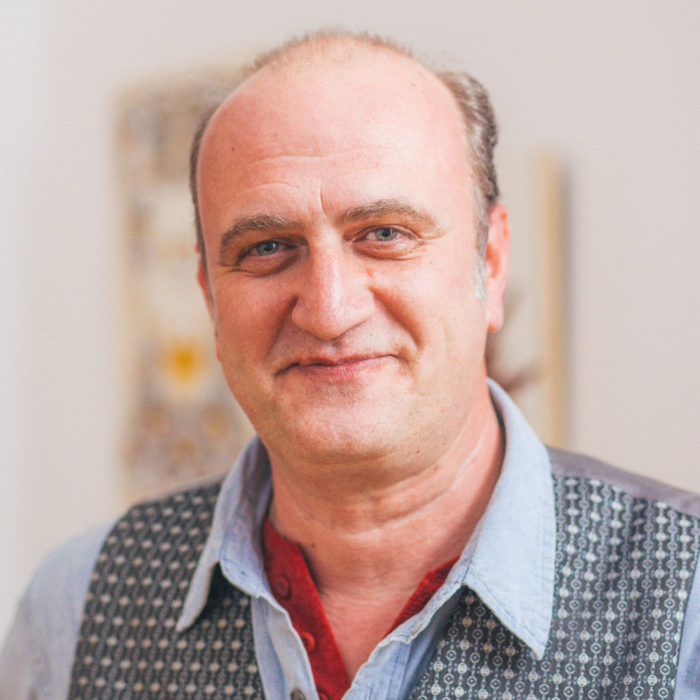
Photo courtesy of Pedro León Zapata

In the ’40s, Zapata moved to Mexico to study with the muralists Diego Rivera and José Clemente Orozco. Over the many years since his return to Venezuela, he has become a nationally known political gadfly and unique artist—painter, muralist, illustrator, playwright, radio host, actor, and musician—revered for both his humor and his implacable challenge to Chávez.
.
In 2000 there was a confrontation with the Venezuelan leader, who publicly challenged Zapata about these cartoons, asking whether he had been bribed to publish them. Zapata answered the President with another question: “Mr. Chávez, did you accept money to refer to my cartoons, thus inducing so many people to rush out and buy the newspaper?”

Zapata is featured on Chávez’s list of “counter-revolutionaries”— a collection of artists, journalists and other “public enemies” the President recommends go into self-imposed exile.

Read an interview with Pedro León Zapata and other persecuted cartoonists in Sampsonia Way.

Slide Show: South African Political Cartoonist Zapiro


Click on images to enlarge. © 2011 Zapiro (All rights reserved) Printed with permission from www.zapiro.com. For more Zapiro cartoons visit www.zapiro.com

Jonathan Shapiro, (Zapiro) born in Cape Town, South Africa, fulfilled his military requirement before becoming active in the anti-apartheid movement, the United Democratic Front. In 1988, on a Fulbright scholarship, he studied at the School of Visual Arts in New York City with premier comic artists Art Spiegelman and Harvey Kurtzman.

Today Zapiro is a noted editorial cartoonist with a busy schedule drawing for South Africa’s Mail & Guardian and Sunday Times.

Photo courtesy of Jonathan Shapiro

He has published 16 book compilations of his work and received the 2007 Courage in Editorial Cartooning award from the Cartoonists Rights Network International, which monitors and supports the well-being of political cartoonists who find themselves in trouble because of the power and influence of their professional work. For several years, he’s been an invited speaker at the World Economic Forum in Davos.
.
According to the Daily Maverick, “He didn’t censor himself before the apartheid government (and he was jailed for it), he doesn’t censor himself to appease big business, and he certainly doesn’t censor himself to please the African National Congress—he is one of those who takes most seriously Section 16 of the South African constitution, the part where freedom of expression is enshrined.”

Read an interview with Zapiro and other persecuted cartoonists in Sampsonia Way.

Burmese Rapper Zayar Thaw: A Left Hand of a Boxer

Burmese Hip-Hop singer Zayar Thaw. Photo: DVB

In 2000, the hip-hop group Acid, of which the popular Burmese rapper Zayar Thaw was a part, released Burma’s first hip-hop album. Despite predictions of failure by many in the Burmese music industry the album stayed at number one on the Burmese charts for more than two months.
Zayar Thaw is also one of four founding members of Generation Wave a pro-democracy youth movement opposed to Burma’s military government, that started in October 2007, following the anti-government protests popularly known as the Saffron Revolution.

Before he was arrested in 2008 Zayar Thaw was combining his music and social activism to perform charity concerts for orphans with HIV. He also visited the orphanages, looked after the children, and helped to teach them English with fellow Burmese rapper, Nge Nge.

Zayar Thaw was arrested with five of his friends in a restaurant in Rangoon on March 12, 2008. He was charged with forming an illegal organization—Generation Wave—and sentenced to six years in prison. He was allegedly beaten during his interrogation. Ten minutes before Zayar Thaw was sentenced, he wrote a statement which was leaked to Generation Wave members. “Tell the people to have the courage to reject the things they don’t like, and even if they don’t dare to openly support the right thing, tell them not to support the wrong thing,” his statement said.

On 20 November 2008, he was sentenced to five years’ imprisonment for illegally organizing under the Unlawful Association Act; Zayar Thaw was given an additional year’s imprisonment for possession of foreign currency. He served his sentence at Kawthaung prison and was released on 17 May 2011.
(more…)

Slide Show: Zimbabwean Cartoonist Tony Namate


Tony Namate recently published a book of his cartoons, The Emperor’s New Clods: Political Cartoons from Zimbabwe, which the Association of American Editorial Cartoonists’ Kevin Kallaugher says, “punctures the pomposity of the powerful on behalf of the poor and the powerless.”

Courtesy of Tony Namate

A picture on Namate’s Facebook page, taken in 1999, shows him at his Daily News desk drawing a cartoon. In April 2000 a homemade bomb was thrown at the paper’s office, and in 2001 a series of bombs were planted in the building, blowing up the printing press. In 2003 the paper, known for its critical views on President Robert Mugabe, was denied a permit and subsequently shut down. Namate now draws for the online periodical New Zimbabwe and also addresses the problems of other African countries.

VJ Movement’s website says of Namate, “His work is often open to different interpretations—an ambiguity he says not only protects him but also reflects the complicated politics of his country. He trusts in his readers’ capabilities to distill his message.”

Read an interview with Tony Namate and other persecuted cartoonists in Sampsonia Way.

Video: Something in the Way of Things (In Town) by Amiri Baraka

On Thursday June 23, City of Asylum/Pittsburgh partnered with the African-American poetry collective Cave Canem to host a reading with poets Toi Derricotte, Cornelius Eady, Natasha Trethewey, and special guest Amiri Baraka.

Amiri Baraka read four of his poems: In Town, Lowkus, Play Dat, and Who Blew Up America?

In this video Sampsonia Way presents Something in the way of things (In Town), that clearly manifests Baraka’s quest for social justice exploring interrelated issues of racial, national oppression, self-determination and national human liberation.

New in SAMPSONIA WAY MAGAZINE: Amiri Baraka discusses politics, the future of black art, and the consequences of making political art in America.

.

Chinese Writer Guo Feixiong Released from Prison

Writer Guo Feixiong, a member of PEN Center, was released from Meizhou Prison in China’s Guangdong Province on September 13. He served a five year sentence. Rights groups and Guo’s wife say that he suffered abuse during his detention and imprisonment, but the activist and writer is reluctant to linger on the details of his “special treatment.”

Guo Feixiong, The Epoch Times

Chinese dissident writer Guo Feixiong in 2006. Photo by The Epoch Times

Guo Feixiong, also known as Yang Maodong, is a Chinese dissident novelist and essayist, independent publisher, and rural civil rights advisor and activist. In 2006 he was charged with selling 20,000 books using false ISBNs, an illegal publishing practice.

According to his wife, Zhang Qing, the charge was unfounded. His lawyers said the arrest was connected to the publication of a book entitled Earthquake of Shenyang Government, which Guo edited but did not write. The book exposed government corruption in China’s Liaoning Province. Despite the government’s claims that he was arrested for business violations, he was only asked about his political activities while in prison.

Guo faced years of government harassment prior to his 2006 arrest. In 2005, as a legal advisor at the Beijing-based Shengzi Law Office, he was detained for more than three months after attempting to help remove a corrupt director from the village of Taishi‘s local committee. Since that detention Guo was repeatedly harassed by authorities. In August 2006, two months before his imprisonment, he was beaten by railway police for allegedly carrying a false ticket on the train. Guo is a member of the Independent Chinese PEN Center (ICPC) and wrote for news websites about Taishi’s perilous political situation, activities which may have contributed to his persecution and arrest.

Zhang Qing, who was granted political asylum in 2009, and now lives in the United States, wrote about Feixiong’s prison experience in a letter to Human Rights in China (HRIC):

“On December 28 [2007] we saw Guo Feixiong at Meizhou Prison for the first time. Through the glass partition, I could see that his body was stiff, and he wobbled as he walked to the visitation area. He was pale and his lips were lifeless; he was emaciated.

He told us that on his first day at Meizhou Prison—December 13, 2007—the prison [guards] threatened him, and forced him to do physical labor… He was not permitted contact with other prisoners, or to read the newspaper or any books from the library. He was not allowed to cross the three yellow security lines painted on the ground in front of his door. They also threatened to send him to a mental hospital.

He began his hunger strike on that day and planned to continue it for 100 days. He was doing this to call upon the Chinese government to improve the prison conditions for political prisoners, prisoners of conscience, and those persecuted for their religious beliefs, and to initiate political reform.

On the fifth day, [the prison guards] secretly arranged for a prisoner to beat him. During the long course of the beating, he tried four times to speak, but prison guards covered his mouth and deliberately injured his chin. The beating occurred in front of 200 prisoners, who were unable to do anything. It wasn’t until [the prisoners] all raised their voices that the beating finally stopped.”

Guo’s hunger strike failed when he became dangerously sick. He confessed to his charges while undergoing torture.

Guo’s poem about the Guangdong Province elections, “Worry Free Songs” was published in the online “Collection of Human Rights Poems,” an anthology of China’s censored history in the new century. Guo was an honorary chief editor of the anthology, which the Chinese government banned in 2008. “Worry Free Songs” has not been properly translated by an authenticated source, but in a rough translation the poem speaks of dreams of political and religious ancestors—“Confucius, Mencius, the Bible, which sustains.”

Although Guo’s treatment in prison has left him physically weakened, he strives towards reconciliation. “I don’t care who did what to me in the past,” he told HRIC. “…I am filled with optimism for the future.”

He also said to the Associated Press: “The only thing I can tell you [about imprisonment] is that I was given special treatment beyond people’s imagination in the detention center and in prison. I don’t want to talk about it in detail. I want to convey a message of forgiveness to the public and not to talk about hatred.”

Guo maintains his political views have not been swayed. “No amount of ‘special treatment’ [in prison] would make me more radical or weaken me. My conviction in defending the rights of people has not changed in the slightest.”

Persecuted Cartoonists: Steady Hands and Brave Hearts

“Books and all forms of writing are terror to those who suppress the truth,” writes Wole Soyinka, Nigerian poet, dramatist and Nobel Prize winner.

Click image to enlarge

The political cartoon is arguably the most powerful format of that terror. More art than speech, the best editorial cartoons are lie-piercing tools in the fight for human rights. With scalpel-sharp wit, they carve away at political power where it holds unhealthy sway. And with their accessibility to a broad swath of followers—illiterate as well as educated—cartoons can become the banners of democracy.

However cartoonists provoke the anger of repressive regimes. The profession requires a steady hand and a brave heart.

In many parts of the world, cartoonists fight for their basic right to freedom of opinion. In perhaps the most infamous brouhaha in contemporary cartoon-publishing history, in September 2005, the Danish newspaper Jyllands Posten attempted to open up debate about a hands-off-Islam demand by the religion’s adherents. The paper published 12 editorial cartoons depicting the prophet Muhammad, which is prohibited under Islamic law. The deed stirred worldwide Islamic protests and retaliations, including the torching of Danish embassies and the attempted murder of one of the artists.

Just like Jylland Posten, there are many publications and cartoonists who have faced pressure from local and international authorities. But unlike the Jylland Posten case they don’t make international headlines.

Sampsonia Way asked writers who have collaborated with the magazine to recommend a cartoonist from their country. From Zimbabwe, it was recommended we contact Tony Namate; from Cuba, Alfredo Pong; from Venezuela, Pedro León Zapata; from Burma, Aw Pi Kyeh (APK); from South Africa, Jonathan Shapiro (Zapiro). We asked them about their careers and challenges and, while editorially we can’t vouch for every one of their opinions, we applaud their efforts to express them and be heard.

Tony Namate: “I Realized the Power of Cartooning, and Haven’t Looked Back Since.”

Tony Namate

Tony Namate

Tony Namate recently published a book of his cartoons, The Emperor’s New Clods: Political Cartoons from Zimbabwe, which the Association of American Editorial Cartoonists’ Kevin Kallaugher says, “The book punctures the pomposity of the powerful on behalf of the poor and the powerless.”

A picture on Namate’s Facebook page, taken in 1999, shows him at his Daily News desk drawing a cartoon. In April 2000 a homemade bomb was thrown at the paper’s office, and in 2001 a series of bombs were planted in the building, blowing up the printing press. In 2003 the paper, known for its critical views on President Robert Mugabe, was denied a permit and subsequently shut down. Namate now draws for the online periodical New Zimbabwe and also addresses the problems of other African countries.

VJ Movement’s website says of Namate, “His work is often open to different interpretations—an ambiguity he says not only protects him but also reflects the complicated politics of his country. He trusts in his readers’ capabilities to distill his message.”

SAMPSONIA WAY: How did you begin as a political cartoonist?

NAMATE: I grew up on American comics and British funnies that my father used to bring from work. I liked the drawings more than the text. Then, when I was in high school in the ’80s, I became addicted to Mad magazine. In high school literature courses I read Julius Caesar and Orwell’s Animal Farm. The resemblance of my country’s political situation to what I read shaped what was to become my political outlook.

Namate Cartoon - Somalia

This cartoon is a dig at the African Union which insists,

SAMPSONIA WAY: What challenges have you faced in response to your cartoons?

NAMATE: I’ve been doing cartoons for over 20 years now, and I have had some close shaves. I’ve been threatened by government ministers and have been chased by a Zanu-PF mob because I “make fun of the President.”

SAMPSONIA WAY: Have you ever come close to giving up your work because of the difficulties imposed on you?

NAMATE: Political cartooning is a labor of love, but yes, there have been times when I thought of giving it up. I have no problem with reactions from politicians; in fact, I welcome their reactions. If their reactions are brutal, then my response is equally brutal. But making a living out of cartooning is not easy because the client base in Zimbabwe is so small and polarized. If you make cartoons for one paper, you can’t make them for another. And payment is a take-it-or-leave-it situation.

Alfredo Pong: “I Suffer an Incurable Case of Castrophobia.”

Alfredo Pong

Alfredo Pong

Alfredo Pong escaped Cuba for Vancouver, Canada in 1991, where he began to draw his first political cartoons. By 1994 he had been hired by the newspaper El Nuevo Herald in Miami, where he continued cartooning for several years. Then in 1998 he connected with the online publication La Nueva Cuba. These days his work is published on websites in the U.S., Brazil, Canada, Spain, Sweden, and Venezuela, and his personal blog can be accessed at cubahumor.com.

Reporters Without Borders has deemed Cuba “one of the world’s 10 most repressive countries, as regards online free expression.” Pong, who has admitted that he suffers an incurable case of “Castrophobia” is among many exiled journalists who continue to fight for a free Cuba.

SAMPSONIA WAY: How did you begin as a political cartoonist?

PONG: I think I started drawing before I could talk. It’s impossible to think of myself as a child and not see me drawing on anything I could find. Then, when I was 8 years old, I was in an art competition in which you used your fingers as paint brushes. I drew a picture of our national hero Fidel Castro and won first prize. Ironically, I had drawn a portrait of the young leader who would later become our tyrant in chief.

SAMPSONIA WAY: What motivated you to use your talent as a means of protest?

PONG: I belong to a generation that was the recipient of every socio-political and economic experiment of the new Cuban utopia, so I witnessed the decline and disintegration of the country we had inherited, the separation of families, the loss of all the material wealth that had been earned and accumulated by at least two generations of Cubans, the annulment of private property, and the right to choose a future for yourself. In short, I witnessed the total loss of individual freedom in the name of a new collective and mandatory way of living.

Alfredo Pong Cartoon

The revolutionary slogan 'Comandante en Jefe, Ordene' means 'Commander in Chief, give us your orders.' Pong modified the word 'ordene' (to give orders) to 'ordeñe', which means to milk a cow.

In Cuba I never published a political cartoon. I knew the publishing circles and almost all the official cartoonists, but I wasn’t willing to pay the price, which would have meant giving up all autonomy and working according to the official “script” of the regime. Instead, I drew comic strips clandestinely, for my own amusement, occasionally sharing some of them with a select group of friends.

When I managed to escape Cuba in 1991, I began to get all that off my chest: The frustration of spending my whole life without being able to denounce the things I had seen, without having the freedom to express my point of view, and always having to look over my shoulder.

SAMPSONIA WAY: Have you ever come close to giving up your work because of the difficulties imposed on you?

PONG: Since the beginning, they have tried to pressure me in all kinds of ways, some very subtle, like trying to block my participation in international graphic humor competitions, or sabotaging the publication of a book that was published in Brazil, which was a collaboration with political analyst Jorge Hernández Fonseca. We put together a book with his work and mine, which was supposed to be released during the International Book Fair in Miami, but it was sabotaged during printing, so it couldn’t be ready for that. Also, none of my cartoons have ever been seen in Cuba because the government blocks all blogs or websites with content that is critical of the regime. I have also received a number of online attacks in different forms.

SAMPSONIA WAY: Have you ever considered stopping your work because of these difficulties?

PONG: Well, I don’t get paid to do this. I live off my work as an architect. Nobody pays me, nobody tells me what to do, and I don’t use ideas other than my own. That gives me a great deal of independence and freedom with my cartoons. I am the only person responsible for what I say, which makes me very happy. I would love for my colleagues in Cuba to be able to enjoy that freedom one day.

Pedro León Zapata: “One Doesn’t Become a Cartoonist, One Unbecomes Oneself.”

Pedro Leon Zapata

Pedro Leon Zapata

Pedro León Zapata isn’t afraid to pick fights —even if his opponent is Hugo Chávez, Venezuela’s authoritarian President. The Caracas-based artist, winner of the Premio Nacional de Artes Plásticas, has been a regular contributor to the popular Venezuelan newspaper El Nacional for nearly 50 years through his column, “Zapatazos.” Interviewed by Elizabeth Farnsworth on PBS in 2002, he said, “How can you explain what is happening in Venezuela if even we Venezuelans can’t understand it? What is happening in Venezuela doesn’t have a logical explanation… In astronomical terms, El Comandante Chávez is a black hole… For me, cartoons are the perfect form for expressing fully all that happens to me inside as a consequence of what is going on outside.” Farnsworth describes Zapata as “a man with a strong appreciation for black humor and the absurd.”

In the ’40s, Zapata moved to Mexico to study with the muralists Diego Rivera and José Clemente Orozco. Over the many years since his return to Venezuela, he has become a nationally known political gadfly and unique artist—painter, muralist, illustrator, playwright, radio host, actor, and musician—revered for both his humor and his implacable challenge to Chávez.

Pedro Leon Zapata cartoon

According to Zapata, this cartoon represents Chávez's party members as toads with epaulettes and military boots. In Venezuela, 'sapo' (toad) is a pejorative term for informants or tattlers.

In 2000 there was a confrontation with the Venezuelan leader, who publicly challenged Zapata about these cartoons, asking whether he had been bribed to publish them. Zapata answered the President with another question: “Mr. Chávez, did you accept money to refer to my cartoons, thus inducing so many people to rush out and buy the newspaper?”

Zapata is featured on Chávez’s list of “counter-revolutionaries” — a collection of artists, journalists and other “public enemies” the President recommends go into self-imposed exile. Although we asked him about his conflict with Chávez, Zapata preferred talking about his public reception.

SAMPSONIA WAY: How did you become a cartoonist?

ZAPATA: One doesn’t become a cartoonist, one unbecomes oneself. I would like to have another profession, but for many reasons I can’t. For example, I wanted to be an architect, but people praised my cartoons so much that I took that path.

SAMPSONIA WAY: What challenges have you faced as a response to your cartoons?

ZAPATA: People really like my cartoons, at least they say so. The only challenge I face is to please the readers without being indulgent.

SAMPSONIA WAY: Have you ever come close to giving up your work because of the difficulties imposed on you?

ZAPATA: I haven’t found a great deal of difficulty in my work, just affection. Nothing has yet made me think about quitting my job as a cartoonist.

Aw Pi Kyeh: “About 300 of my Cartoons Were Censored in my Life.”

Aw Pi Kyeh

Aw Pi Kyeh

Aw Pi Kyeh (APK) chose this pen name because it means ‘loudspeaker’ in Burmese. His cartoons dare to shout out loud about the military junta that rules Burma. In 2007 he was banned from publishing inside Burma after he supported monks in their peaceful protests during the Saffron Revolution. Following that, colleagues who even mentioned his name in an article were suppressed.

In June 2011, the Burmese site Mizzima.com, compiled the views of several well-known Burmese on the fighting between the national troops and the Kachin Independence Army, after both sides suffered heavy casualties. Aw Pi Kyeh commented, “The president said they would try to be a good government. What does good government mean? Is fighting good?”

After 30 years of cartooning, Aw Pi Kyeh says he will not quit. He continues to illustrate despite the ban on his work, and he has turned to new channels of distribution such as Facebook.

SAMPSONIA WAY: How did you begin as a political cartoonist?

APK: I have loved cartoon drawings since I was 9 years old and began copying them. Then I discovered editorial cartoons in newspapers: Not only pictures, but ideas! So I began sending some of my own cartoons about current events to newspapers, but without success. When I reached university, though, my work achieved campus-wide fame. In 1980 editors of magazines began to print my cartoons, and I was given a monthly platform. But at that time in Burma, editorial cartoons were published strictly for propaganda. As soon as I was seen as having new ideas, I was not asked to draw regularly, and in fact I was appointed as an engineer in a factory that was far away from Yangon, where there was no post office. So in 1988 I resigned and became a full-time freelance cartoonist.

Aw Pie Kyeh

After Burma suffered the loss of more than 138,000 lives and damage estimated at $10 billion in Cyclone Nargis in May 2008, the Burmese military regime held a referendum to retain its power. The cartoon depicts a man in trousers (a symbol of a military person) carefully righting his chair (a symbol of power) while ignoring the plight of victims being blown about in the cyclone.

SAMPSONIA WAY: What challenges have you faced as a response to your cartoons?

APK: The crucial challenge is censorship. The Press Scrutiny and Registration Division (PSRD) reads all published books, newspapers, and magazines and censors any pages they don’t like. Publishers and editors need to tear out or ink over those pages. All my cartoons were chosen to be published in magazines, but some were censored. Whenever a page with my cartoon on it is torn out, the cartoon on the back is also tossed out. The editors must allow the PSRD to check their publication again after the deletions. It can take more than a week and delay distribution. So I am a major headache for my editors. Though they would like to publish my work, I am the cartoonist most prone to censorship. I’ve had about 300 of my cartoons cut out of publications in my career.

SAMPSONIA WAY: Have you ever come close to giving up the work because of the difficulties imposed on you?

APK: No. After I resigned from my engineer job, I was determined to be a freelance cartoonist for the rest of my life. I have tried to survive economically, even with a wife and three children. When my cartoons were censored, sometimes I was not paid, so I have also done cartoon illustration, computer graphics, and animation related to cartoons. From time to time, I worked as an external supervisor for some NGOs in creating information, education, and communication materials. Now I draw cartoons not only for criticism but to inform and educate the Burmese people. Cartoons are an easy, effective tool for this purpose. I am particularly interested in using my cartoons to promote environmental issues, disaster management, and early-childhood development. I would never give up my cartoon work because I have so many goals to achieve that censorship will not impact.

Zapiro: “I Was Detained Without Trial in 1988.”

Jonathan Shapiro - Zapiro

Jonathan Shapiro (Zapiro)

Jonathan Shapiro (Zapiro), born in Cape Town, South Africa, fulfilled his military requirement before becoming active in the anti-apartheid movement, the United Democratic Front. In 1988, on a Fulbright scholarship, he studied at the School of Visual Arts in New York City with premier comic artists Art Spiegelman and Harvey Kurtzman.

Today Zapiro is a noted editorial cartoonist with a busy schedule drawing for South Africa’s Mail & Guardian and Sunday Times. He has published 16 book compilations of his work and received the 2007 Courage in Editorial Cartooning award from the Cartoonists Rights Network International, which monitors and supports the well-being of political cartoonists who find themselves in trouble because of the power and influence of their professional work. For several years, he’s been an invited speaker at the World Economic Forum in Davos.

According to the Daily Maverick, “He didn’t censor himself before the apartheid government (and he was jailed for it), he doesn’t censor himself to appease big business, and he certainly doesn’t censor himself to please the African National Congress—he is one of those who takes most seriously Section 16 of the South African constitution, the part where freedom of expression is enshrined.”

Zapiro cartoon

South African cartoonist Zapiro responded to the threats that followed his cartoon of prophet Muhammad visiting the psychologist by drawing himself on the therapist’s couch. While maintaining the right to draw, he dissociated himself from the “juvenile Islamophobic Facebook campaign,” the Islamophobia of the U.S. war on terror, and the European bans on the burqa and minarets.

SAMPSONIA WAY: How did you become a cartoonist?

ZAPIRO: From the age of 8 or 9, I knew that cartooning was my favorite thing. At 4, I remember reading [Carl] Giles. But the big ones for me were Peanuts and Tintin, which I discovered at about 7 and 8. Those cartoons are still two of my great inspirations. Schulz and Hergé are geniuses. At 13, I started to make a book based on the Tintin action films to impress Hergé and get him to let me be part of his team. Then I decided, no, I wanted to do my own stuff.

At the age of 15, there was some pressure to “be something,” and, of course, there was that ogre, the army. I thought I’d better do something “proper” to stay out of the bloody army. Architecture seemed a good marriage of arts and science. I got into Cape Town University easily enough, but I realized architecture was not where my heart was.

Although I thought of being a cartoonist from a young age, it was only when I became a political activist in my mid-20s that I really became a cartoonist. Drawing cartoons for political organizations is what really got me started.

SAMPSONIA WAY: What challenges have you faced as a response to your cartoons?

ZAPIRO: I’ve been involved in a large number of controversies around my cartoons, beginning with the very first political pamphlet I ever did, which was banned by the apartheid government in 1983. Other bits of graphics and cartoons I did were also banned. I was interrogated by the security police about one of them and was detained without trial in 1988. The same year an apartheid cabinet minister ranted in parliament about cartoonists, apparently attacking me and a colleague. Many of my cartoons about political, religious, and sexual issues have been controversial and have sparked debate in newspapers and other media.

But nothing I’ve ever done has come close to creating the kind of media frenzy and public debate sparked by my September 2008 Sunday Times “Rape of Justice” cartoon.

SAMPSONIA WAY: Have you ever come close to giving up the work because of the difficulties imposed on you?

ZAPIRO: For me the problems that I sometimes face are part of the job. My best way of dealing with this is to keep doing hard-hitting cartoons and not get intimidated. I have no plans to stop doing cartoons.

Current Issue: Text-Only Version
Pittsburgh Literary Calendar